Why God Never Intended Us to Grieve Alone
“Two are better than one… If either of them falls, one can help the other up.”
— Ecclesiastes 4:9–10 (NIV)
There are moments in life when you discover who your village really is. Sometimes it happens during a celebration. A graduation. A wedding. The birth of a child.
But sometimes…
it happens during one of life’s deepest heartbreaks.
Over the past several weeks, my family and I have experienced one of those sacred moments.
While saying goodbye to my father, we were surrounded by an overwhelming expression of love. Family members traveled across the country. Friends whom I had not seen in years suddenly appeared. People my father knew decades ago when we lived in New York reached out with stories, prayers, and memories that reminded us just how many lives he had touched.
Our church family prayed before we asked.
My fellow ministers stood beside us.
Members of our MIT family showed up without hesitation.
Meals filled our home.
Flowers filled our tables.
Phone calls filled our days.
Love filled our hearts.
Some people came simply to sit.
Others hugged us without saying a word.
Looking back now, I realize they were doing something far more significant than offering sympathy.
They were helping us heal.
One conversation has stayed with me.
A dear friend looked at me and said,
“Colleen, we may not have known your father personally… but we know you. Because of the way you have loved people, served people, encouraged people, and cared for others over the years, it isn’t surprising that people are showing up for you.”
I have thought about those words many times. Not because they praised me. But because they reminded me that every act of kindness we extend into the lives of others has the potential to become part of a legacy we may never fully see.
My father spent his life serving people.
He preached.
He mentored.
He prayed.
He encouraged.
He visited.
He showed up.
Today, as I continue serving through ministry, teaching, coaching, writing, and creating faith-based creative therapy resources, I realize I am not simply continuing his work—I am extending his legacy in the unique way God has called me to serve. That realization humbled me.
It also reminded me why the message behind We Get To Serve (WGTS) has become so personal. We don’t have to serve. We get to.
God Designed Us for Community
One of the greatest misconceptions about strength is believing we should carry life’s burdens alone. From the very beginning of Scripture, God established community. The early Church prayed together.
They ate together. They mourned together. They celebrated together. Galatians 6:2 reminds us,
“Carry each other’s burdens, and in this way you will fulfill the law of Christ.”
Notice Paul does not say, “Watch people carry their burdens.” He says… Carry them. God never intended grief to become an isolated journey. He designed healing to happen in relationships.
The Science Behind the Village
What Scripture has taught for thousands of years, neuroscience is now helping us understand in remarkable ways.
Researchers describe a concept called co-regulation.
Co-regulation occurs when the calm presence of another person helps regulate our own nervous system. A hug. A handheld during prayer. Someone quietly sitting beside you. A reassuring voice. Even sharing a meal together. These simple acts communicate safety to the brain.
When we experience compassionate presence, our nervous system begins to shift from survival toward regulation. Heart rate slows. Breathing becomes more rhythmic. Stress hormones gradually decrease while hormones associated with connection and trust, such as oxytocin, increase.
In other words,… Sometimes healing begins before a single word is spoken. Science now confirms what the Church has practiced for generations. The Ministry of presence matters.
Perhaps this explains why Job’s friends ministered most effectively during the first seven days they simply sat with him in silence (Job 2:13).
Sometimes the greatest gift we can give another person is not advice. It is ourselves.
Creative Therapy and Community
One of the unexpected gifts I received during this season was a journal. Ironically, it wasn’t one of my own WGTS journals. Someone simply thought enough of me to say,
“You may need a place to write.”
That simple gift reminded me of why I created creative therapy resources in the first place. Journaling.
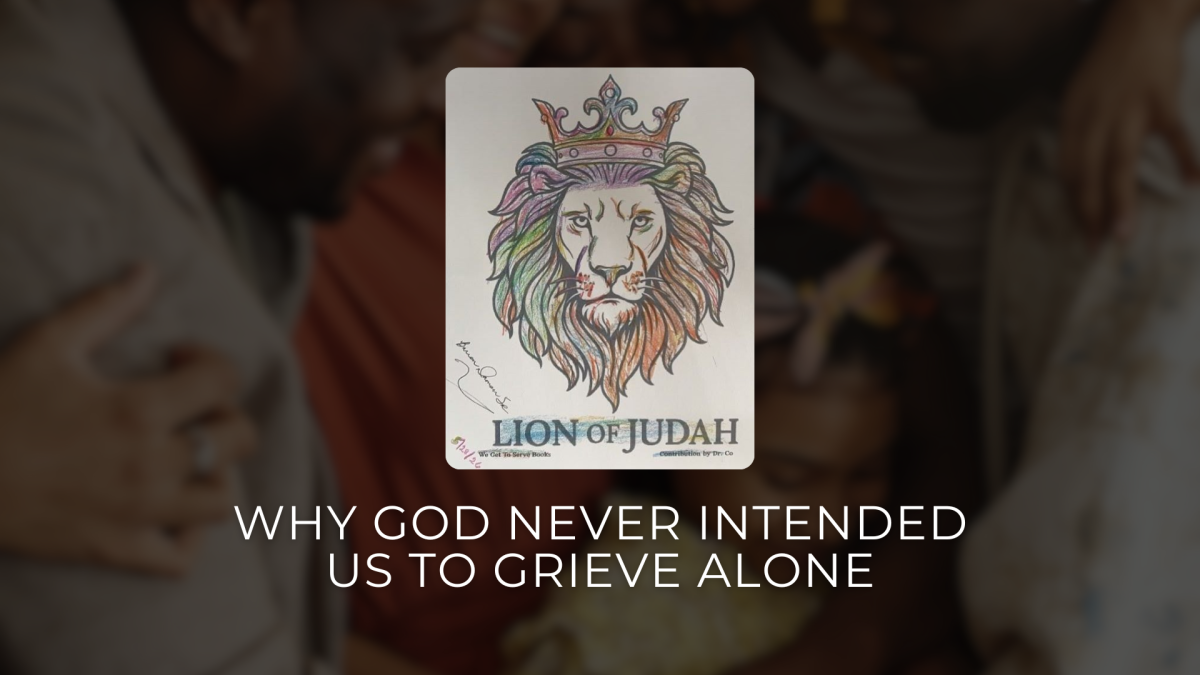
Coloring, Reflection, Prayer, Scripture. These practices become sacred spaces where our emotions are acknowledged instead of ignored.
Research from the National Institutes of Health, Harvard Health Publishing, and the American Art Therapy Association continues to demonstrate that expressive writing and creative engagement can reduce stress, improve emotional processing, and support resilience during seasons of grief and transition.
Science helps explain the process; Faith gives it purpose. As Christians, we know healing is ultimately God’s work. Yet He often chooses to work through the people He places around us and through the gifts He has placed within us.
The Legacy of Love
As the funeral ended…
The flowers slowly faded.
The meals eventually stopped arriving.
Visitors returned home.
Life began moving again.
But something remained.
Love.
Not just the memory of being loved…
The evidence of it.
Every phone call.
Every prayer.
Every visit.
Every meal.
Every handwritten card.
Every embrace.
They became reminders that God had never left us alone.
His presence often arrived wearing the face of another person.
That may be one of the greatest lessons my father’s life continues to teach me. Legacy is not measured only by what we accomplish. Legacy is measured by the people who continue loving because we first loved them. That is a legacy worth leaving. And that is the kind of village I pray each of us continues building.
Village Reflection
- Who has been part of your healing village during life’s difficult seasons?
- Who showed up when you least expected it?
- Have you thanked them?
- Is there someone in your own community who needs you to simply be present this week?
- How might God be inviting you to become part of someone else’s healing village?
Faith & Science
Key Scriptures
- Ecclesiastes 4:9–10
- Galatians 6:2
- Romans 12:15
- Job 2:13
Neuroscience Focus
- Co-regulation
- Social connection and nervous system regulation
- Oxytocin and emotional resilience
- Neuroplasticity through healthy relationships
References
- Mayo Clinic — Social support, stress, and resilience
- Harvard Health Publishing — The health benefits of strong social connections
- National Institutes of Health (NIH) — Social support and psychological resilience
- American Psychological Association — Community support and coping with grief
- American Art Therapy Association — Creative expression during grief
Come back next week for this six-part series. For me writing is therapeutic.
The Legacy We Carry How Love, Faith, and Mirror Neurons Shape the Next Generation